
Bannerstones: The Complete Guide to Identification, Types and Value
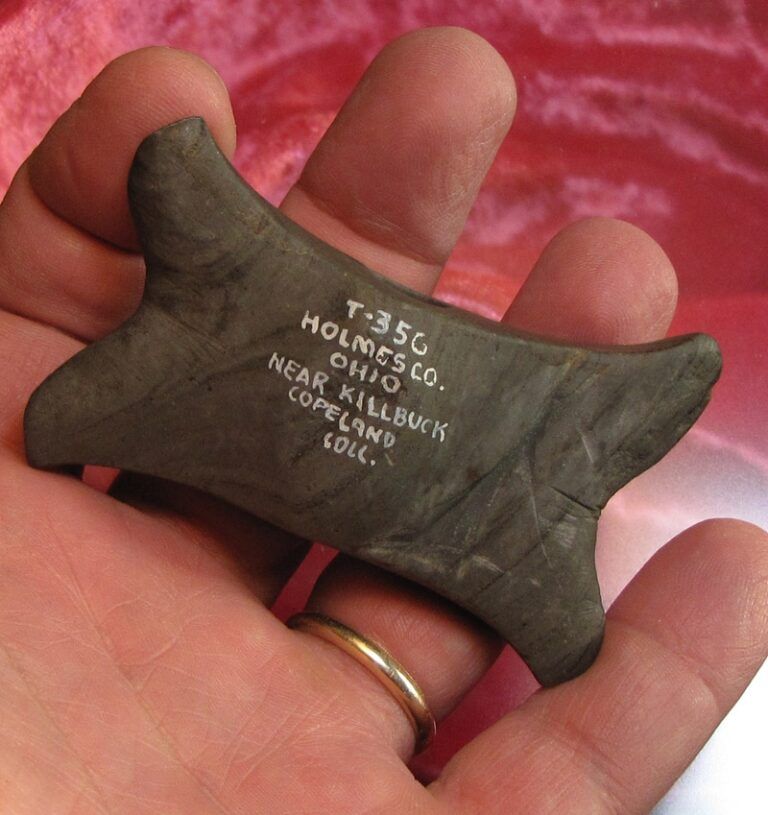
A bannerstone is a carved and polished stone artifact with a hole drilled through its center, made by Native American people across eastern North America during the Archaic period, roughly 8,000 to 3,000 years ago. They come in dozens of shapes, from the familiar butterfly to crescents, picks, tubes and hourglasses, and many are carved from beautiful materials like banded slate, quartz and granite. Most researchers connect them to the atlatl, the spear-thrower that came before the bow and arrow, but their exact purpose is still debated.
Whether you just found one in a field, inherited a family collection or are thinking about buying your first piece, this guide covers what bannerstones are, how they were made and used, the main types, how to tell a genuine bannerstone from a reproduction and what makes one valuable.
What Is a Bannerstone?
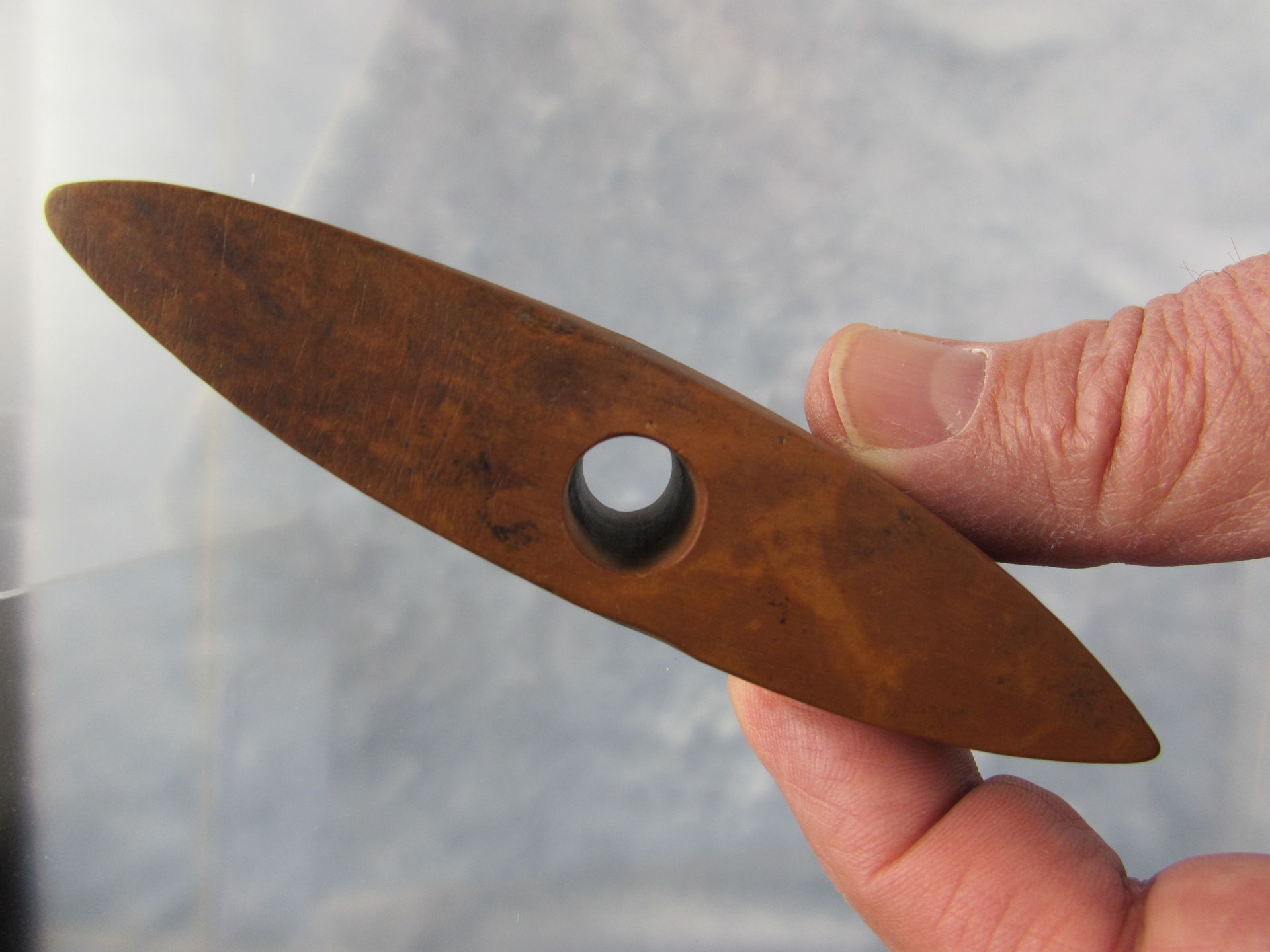
Bannerstones are ground-stone objects, which means they were shaped by pecking, grinding and polishing rather than by chipping like an arrowhead. Almost every finished bannerstone has a single hole drilled through the middle, usually lengthwise along the center line. That perforation is the defining feature: it suggests the stone was meant to slide onto a shaft or handle.
The name is older than the science. Early collectors imagined the stones mounted on staffs and carried like banners or emblems, and the term "bannerstone" stuck even after researchers began to favor a more practical explanation. Today the word covers a wide family of related forms, which the classic study by Byron Knoblock, Banner-stones of the North American Indian(1939), first sorted into types.
Bannerstones are found mainly in the Midwest, the Southeast and the Northeast, with especially rich finds in states like Ohio, Indiana, Illinois, Kentucky, Tennessee, Michigan and Wisconsin. Regional styles are distinct enough that an experienced collector can often tell where a piece came from by its shape and material alone.
How Old Are Bannerstones?
Bannerstones belong to the Archaic period, the long stretch of North American prehistory between the end of the Ice Age hunters and the rise of pottery and farming villages. Most date to the Middle and Late Archaic, roughly 8,000 to 3,000 years ago, and some forms continued into the Early Woodland period.
Different shapes were popular at different times, so a bannerstone's type is itself a clue to its age. Researchers date them by the company they keep: bannerstones found in the same layers or graves as datable projectile points, or at excavated sites with radiocarbon dates. David L. Lutz spent decades on exactly this question in his book The Archaic Bannerstone, which is reviewed in A Salute to David L. Lutz. For a closer look at how forms changed over time, see A Chronology of Bannerstones.
What Were Bannerstones Used For?
No one has found a bannerstone still attached to a complete, preserved weapon, so their purpose has to be pieced together from the evidence. Here are the leading explanations.
Atlatl weights
The most widely accepted theory is that bannerstones were mounted on the atlatl, a spear-throwing stick that let hunters launch darts with far more force than throwing by hand. The strongest evidence comes from Archaic burials, most famously at Indian Knoll in Kentucky, where archaeologists found bannerstones lying in line with antler atlatl hooks and handles, just where they would sit on a wooden atlatl that has since decayed. Learn more about the weapon itself in The Atlatl and Bannerstone and Native American Hunting Technique.
Even within this theory, there is debate about what the stone actually did. Some argue it added balance or momentum to the throw, others that it was more symbolic than mechanical, since experiments show an atlatl works well without one.
Symbols of identity and status
Many bannerstones took enormous effort to make and were carved from rare, striking stone, far more than a simple weight would need. That has led researchers like David Lutz to argue they were emblems of identity, marking a person's kinship group or clan, and that they may have had value in long-distance trade. Some were deliberately broken, or "ceremonially killed," before being placed with the dead.
Other theories
Over the years, bannerstones have also been proposed as weights for spindles or fire drills, as ceremonial objects carried on staffs and as tools for straightening shafts. None of these has the supporting evidence of the atlatl connection, and the truth may be that bannerstones served more than one purpose across thousands of years. You can read more about the debate in What Were Bannerstones Used For?
How Bannerstones Were Made
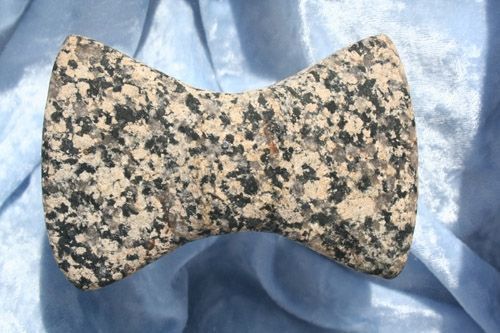
Making a bannerstone was slow, skilled work. The maker selected a stone, roughed out the shape by pecking it with a harder hammerstone, then ground it down with sandstone and sand and polished it smooth. Hard stones like granite and quartz could take many weeks of work.
The center hole was usually drilled with a hollow tool, such as a length of cane, spun against the stone with sand and water as the abrasive. This leaves a cylindrical core and fine circular striations inside the hole, a detail collectors look at closely. Some bannerstones were finished in every way except the drilling. Why they were left undrilled is one of the open questions that researchers still discuss.
Bannerstone Types
The Archaic Bannerstone Project, led by Dr. Anna Blume, recognizes 24 bannerstone types based on Knoblock's original system, many with several sub-types. You can browse examples on the Archaic Bannerstone Project site and in our Bannerstone Typology article. The types collectors see most often include:
- Butterfly: two broad wings on either side of the hole, including single-notched, double-notched and quartz varieties. The classic bannerstone shape. See Butterfly and Winged Bannerstones.
- Wisconsin wing: a winged form associated with the upper Midwest.
- Crescent: curved, moon-shaped wings, including double, notched and knobbed forms.
- Pick: long, narrow wings tapering to points, in curved and straight versions.
- Tube: a drilled cylinder in round, oval, square or triangular cross-section. See Benton Phase Tubular Bannerstones.
- Bottle: a rounded body with a neck, resembling a bottle.
- Hourglass: pinched in the middle, flared at both ends.
- Ovate: an egg-shaped outline, with northern, southern and notched forms.
- Geniculate: a bent or kneed form.
- Others: reel, shuttle, saddleface, lunate, hinge, humped, panel, shield, rectangular, triangular, ball and double-edged forms.
Within each type, the material, size and region make every piece different. The Terry McGuire and Ed Harvey collections show how wide that range can be, from a 2.4 inch quartz hourglass to a 7.75 inch knobbed crescent.
Bannerstone Materials
Archaic sculptors chose their stone with care, and material is one of the first things collectors notice. Common materials include:
- Banded slate: the most familiar bannerstone material, prized for its dramatic stripes. Most common in Ohio, Indiana and Michigan.
- Granite and other hardstones: speckled and extremely durable, but very difficult to shape.
- Quartz and quartzite: including clear, green and ferruginous quartz. Quartz butterflies are among the most admired forms.
- Hematite, steatite and claystone: used in some regions and types.
Because harder stones took far more work, a well-made hardstone or quartz bannerstone often carries a premium.
How to Identify a Genuine Bannerstone
Reproductions are common in the artifact market, so it pays to look carefully. No single sign proves authenticity, but these are the things experienced collectors check:
- The drill hole: ancient holes made with a hollow drill show fine, uneven circular striations and are rarely perfectly straight. A glassy-smooth, perfectly uniform hole can be a warning sign of a modern drill.
- Surface and patina: genuine pieces show age in the surface, with mineral deposits, soil staining and even weathering, especially in crevices and inside the hole.
- Wear and damage: old breaks, plow marks and use wear that look consistent with the stone's history, rather than fresh chips or artificial aging.
- Form and material: the shape and stone should match known types from the region where the piece was reportedly found.
- Provenance: a documented history of who found it, where and when, and which collections it passed through. Good collector history adds both confidence and value.
When in doubt, get an expert opinion before you buy or sell. Clear photos of each side and of the hole, taken with a ruler for scale, make an assessment much easier. Our guide to photographing bannerstones explains how, and Bannerstone Metrics covers the measurements researchers record.
What Is a Bannerstone Worth?
Bannerstone values vary widely, from modest prices for fragments and common types to many thousands of dollars for exceptional, well-documented examples. The main factors are:
- Type and rarity: some forms, like quartz butterflies or rare hooked and clipped-wing types, are scarce and in high demand.
- Material: striking banded slate, quartz and hardstones usually bring more than plain stone.
- Size and symmetry: larger pieces with balanced, well-executed lines are more desirable.
- Condition: complete, unrestored pieces are worth more than broken or repaired ones.
- Provenance: a documented find location and a history in respected collections can significantly increase value.
The best way to know what yours is worth is to have it looked at. We offer a free bannerstone appraisal: send clear photos and a real person will reply within 24 hours with what you have and what it may be worth, with no cost and no pressure.
Is It Legal to Buy and Sell Bannerstones?
In the United States, artifacts found on private land with the landowner's permission can generally be collected, bought and sold, subject to state law. It is illegal to remove artifacts from federal or tribal land, and items connected to burials are protected. Laws such as the Archaeological Resources Protection Act and the Native American Graves Protection and Repatriation Act (NAGPRA) set these limits, and some states add their own rules.
We only buy artifacts that were legally obtained, found on private property with permission and not taken from graves. Read more in How to Sell Native American Artifacts.
Bannerstone FAQ
What is a bannerstone?
A bannerstone is a carved and polished stone artifact with a hole drilled through the center, made by Native Americans in eastern North America during the Archaic period, roughly 8,000 to 3,000 years ago.
What were bannerstones used for?
Most researchers believe they were mounted on the atlatl, or spear-thrower, based on burials where bannerstones lie in line with atlatl parts. Many may also have been symbols of identity or status.
How old are bannerstones?
Most date to the Middle and Late Archaic periods, roughly 8,000 to 3,000 years ago, with some forms continuing into the Early Woodland period.
Where are bannerstones found?
Mainly in the eastern United States, especially the Ohio, Mississippi and Tennessee river valleys and the Great Lakes region, in states like Ohio, Indiana, Illinois, Kentucky, Tennessee, Michigan and Wisconsin.
How can you tell if a bannerstone is real?
Look at the drill hole for ancient hollow-drill striations, check for natural patina and weathering, compare the form and material to known regional types and ask for provenance. An expert appraisal is the safest way to be sure.
How much is a bannerstone worth?
Anywhere from modest amounts for fragments and common types to many thousands of dollars for rare, well-documented pieces. Type, material, size, condition and provenance all matter.
Have a Bannerstone? Find Out What You Have
Bannerstones are some of the most beautiful and mysterious objects left by North America's ancient peoples, and every one carries a piece of that story. If you have a bannerstone, a birdstone, a gorget or a whole collection, we can help you understand it.
Get a free appraisal or learn how we buy bannerstones, from single pieces to entire collections.