
Pick Bannerstones: Identification, Types and History
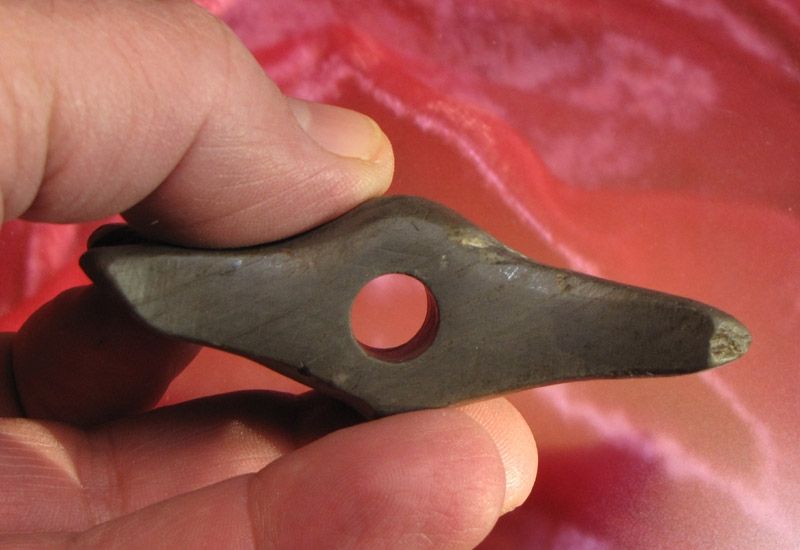
The pick bannerstone gets its name from its shape: a long, slightly curved stone with pointed ends and a hole drilled through the middle, like the head of a pick. It is one of the oldest and most widespread bannerstone forms, with examples ranging from early Middle Archaic sites in North Carolina to elegant banded slate picks from the Northeast.
This guide covers how to identify a pick bannerstone, the main pick sub-types, how picks were made and what collectors look for. For an overview of all bannerstone forms, see Bannerstones: The Complete Guide.
What Is a Pick Bannerstone?
A pick bannerstone is semilunar, or pick-shaped, and round in cross section. The body curves slightly, with the ends pointing back toward one side of the central hole. The ends taper to a rounded point, although some regional styles, including examples from North Carolina, have flattened ends.
The pick is one of the 24 bannerstone types recognized by the Archaic Bannerstone Project, which builds on Byron Knoblock's 1939 classification in Banner-stones of the North American Indian. Its closest relative is the crescent bannerstone, which has a similar curved outline but broad, rounded wing tips instead of points.
Pick Bannerstone Sub-Types
- Curved pick: the classic form, with a gentle curve along its length. Curved picks are one of several bannerstone forms particular to the Northeast. A well-known banded slate example from Glens Falls, New York, is in the American Museum of Natural History.
- Straight pick: a straighter body with little curve.
- Single-pronged pick: a form with a single projecting end.
The Stanly Culture and Early Pick Bannerstones
Some of the earliest dated bannerstones are pick types from the North Carolina Piedmont. Archaeologists have linked pick bannerstones to the Stanly culture of the Middle Archaic period, known for its Stanly projectile points, which date to roughly 7,800 to 7,500 years ago at the Doerschuk site on the Yadkin River. Pick bannerstones have been described as the atlatl weight of the Stanly culture.
Finds from the Hardaway site in North Carolina show how picks were made: blanks were roughly flaked to shape, pecked to their final form, drilled and then ground and polished. Pick-style bannerstones continued to be made much later as well, which is one reason the type is so widespread.
How to Identify a Pick Bannerstone
- Outline: long and narrow with a slight curve, the ends angling back from the hole.
- Cross section: rounded rather than flat.
- Ends: tapering to a rounded point, or flattened in some regional styles. Broad, rounded wing tips suggest a crescent instead.
- Perforation: drilled at the center. Look for the fine circular striations of ancient drilling inside the hole.
- Material: varies by region, from local stones in the Southeast to banded slate in the Northeast and Midwest.
What Is a Pick Bannerstone Worth?
Value depends on the sub-type, material, size, symmetry, condition and provenance. Long, balanced picks in fine banded slate with intact tips are the most desirable, and documented early examples are of special interest. For a realistic value, get a free bannerstone appraisal.
Pick Bannerstone FAQ
What does a pick bannerstone look like?
A long, slightly curved stone with a round cross section, pointed ends and a hole drilled through the center, similar to the head of a pick.
How old are pick bannerstones?
Some of the earliest are linked to the Middle Archaic Stanly culture of North Carolina, roughly 7,800 to 7,500 years ago, and the form continued to be made long afterward.
What is the difference between a pick and a crescent bannerstone?
A pick has narrower wings ending in points, while a crescent has broad, rounded wing tips.
Have a Pick Bannerstone?
Send clear photos of each side and the drill hole, with a ruler for scale, for a free appraisal. We buy single pieces and whole collections. Learn how we buy bannerstones, or browse more bannerstone types.