
Tube Bannerstones: Tubular Bannerstone Identification and History
The tube bannerstone, also called a tubular bannerstone, is a stone cylinder drilled through its length. It looks simple next to a winged butterfly, but tubes come in a surprising range of shapes and materials, and some regional styles, like the Benton phase tubulars of Mississippi, are among the most distinctive bannerstones of the Archaic period.
This guide covers how to identify a tube bannerstone, the main tube sub-types, the Benton phase tubulars and what collectors look for. For an overview of all bannerstone forms, see Bannerstones: The Complete Guide.
What Is a Tube Bannerstone?
A tube bannerstone is an elongated piece of stone with the perforation running along its long axis, so the stone forms a tube around the hole. Unlike winged bannerstones, tubes have no wings extending from the center. Tube is one of the 24 types recognized by the Archaic Bannerstone Project, following Byron Knoblock's 1939 system in Banner-stones of the North American Indian.
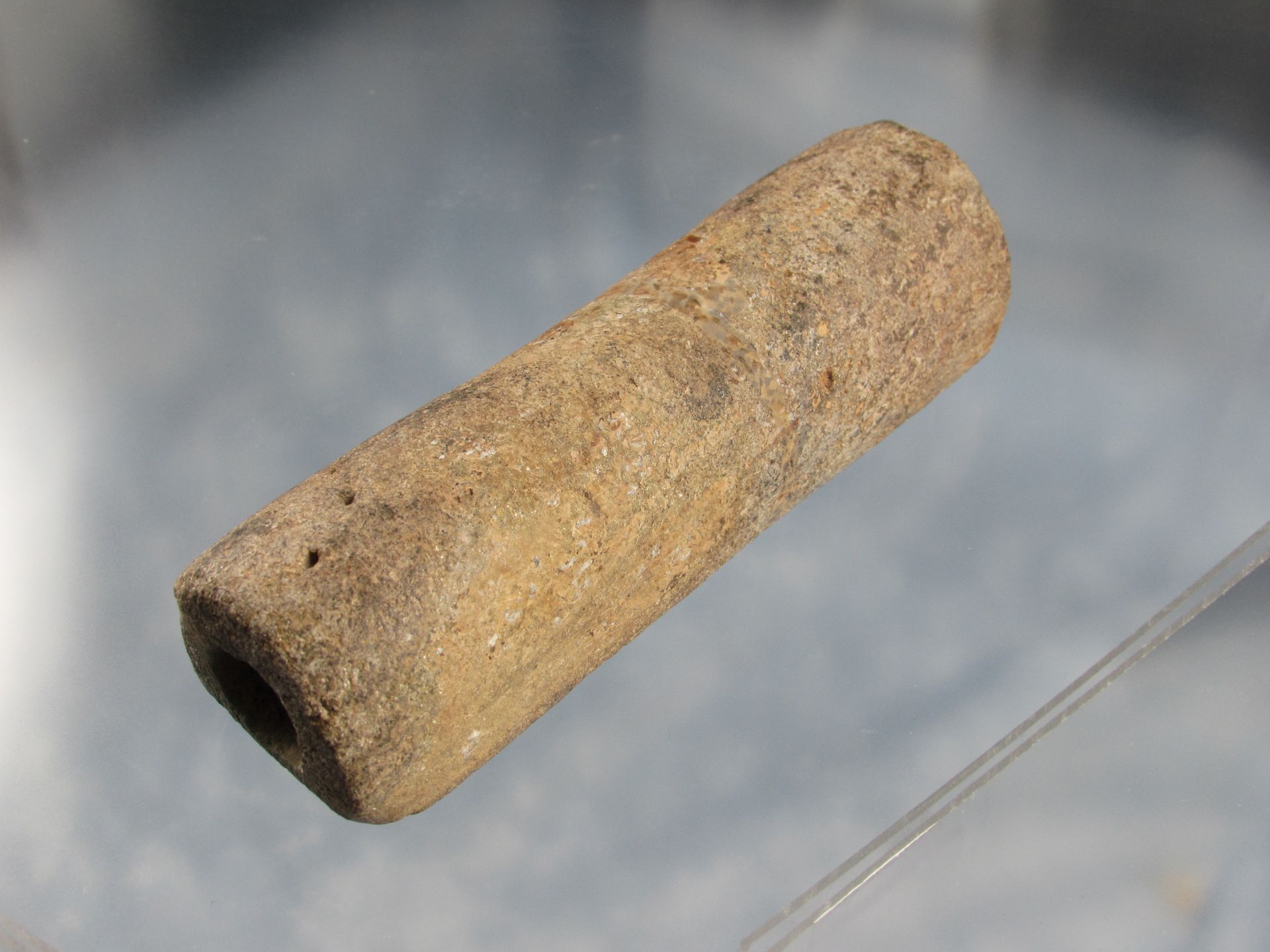
Tube Bannerstone Sub-Types
Tubes are usually described by their cross section:
- Round tube: a true cylinder.
- Oval tube: flattened slightly into an oval cross section.
- Square or rectangular tube: squared sides, including the rectangular tubes known from Tennessee.
- Triangular tube: three flattened faces.
- Fluted tube: a tube with a groove, or flute, running its length on one side. Fluted bannerstones are most often tube forms.
Benton Phase Tubular Bannerstones
The tubular form was a favorite of the Benton culture of the Middle to Late Archaic, and many examples come from northeast Mississippi, where Benton peoples lived. Dr. J. Neal Brown dates the Benton phase in northeast Mississippi mostly to around 3700 to 3200 B.C.
The most often seen Benton style is nicknamed the "covered wagon" by collectors, because its profile resembles a Conestoga wagon. Brown notes these were most often made from mint-green claystone, likely from the Ouachita Mountains of Arkansas. The drill hole usually runs parallel to the white banding in the stone, and the finest examples have a concave top edge. Read Dr. Brown's full article, The Unique Styles of Mississippi Benton Phase Tubular Bannerstones.
How to Identify a Tube Bannerstone
- Shape: elongated, with no wings, and the hole running lengthwise through the stone.
- Cross section: round, oval, square, rectangular or triangular.
- Perforation: ancient drilling leaves fine circular striations and is rarely perfectly uniform. A glassy, machine-perfect bore is a warning sign.
- Material and banding: regional stones such as claystone, slate and hardstones. On banded pieces, note how the banding runs relative to the hole.
- Do not confuse with beads or pipes: tubes are larger and heavier than most beads, and unlike tube pipes they are not flared or bowl-shaped at one end.
Where Are Tube Bannerstones Found?
Tube bannerstones are found across the Southeast and Midwest, with notable concentrations in Mississippi, Tennessee, Alabama and Georgia, including Archaic sites along the Savannah River. Regional styles and materials help collectors place a tube's origin.
What Is a Tube Bannerstone Worth?
Value depends on the style, material, size, symmetry, condition and provenance. Well-made Benton covered wagon tubulars in mint-green claystone and documented examples from known sites draw strong collector interest. For a realistic value, get a free bannerstone appraisal.
Tube Bannerstone FAQ
What is a tubular bannerstone?
A bannerstone shaped like a tube, with the hole drilled lengthwise through an elongated stone and no wings.
What is a covered wagon bannerstone?
A collector nickname for the most common Benton phase tubular style from Mississippi, whose profile resembles a Conestoga wagon.
How old are tube bannerstones?
They date to the Archaic period. Benton phase tubulars in northeast Mississippi date mostly to around 3700 to 3200 B.C.
Have a Tube Bannerstone?
Send clear photos of each side and down the drill hole, with a ruler for scale, for a free appraisal. We buy single pieces and whole collections. Learn how we buy bannerstones, or browse more bannerstone types.