
Banded Slate Bannerstones: The Collector's Favorite Stone
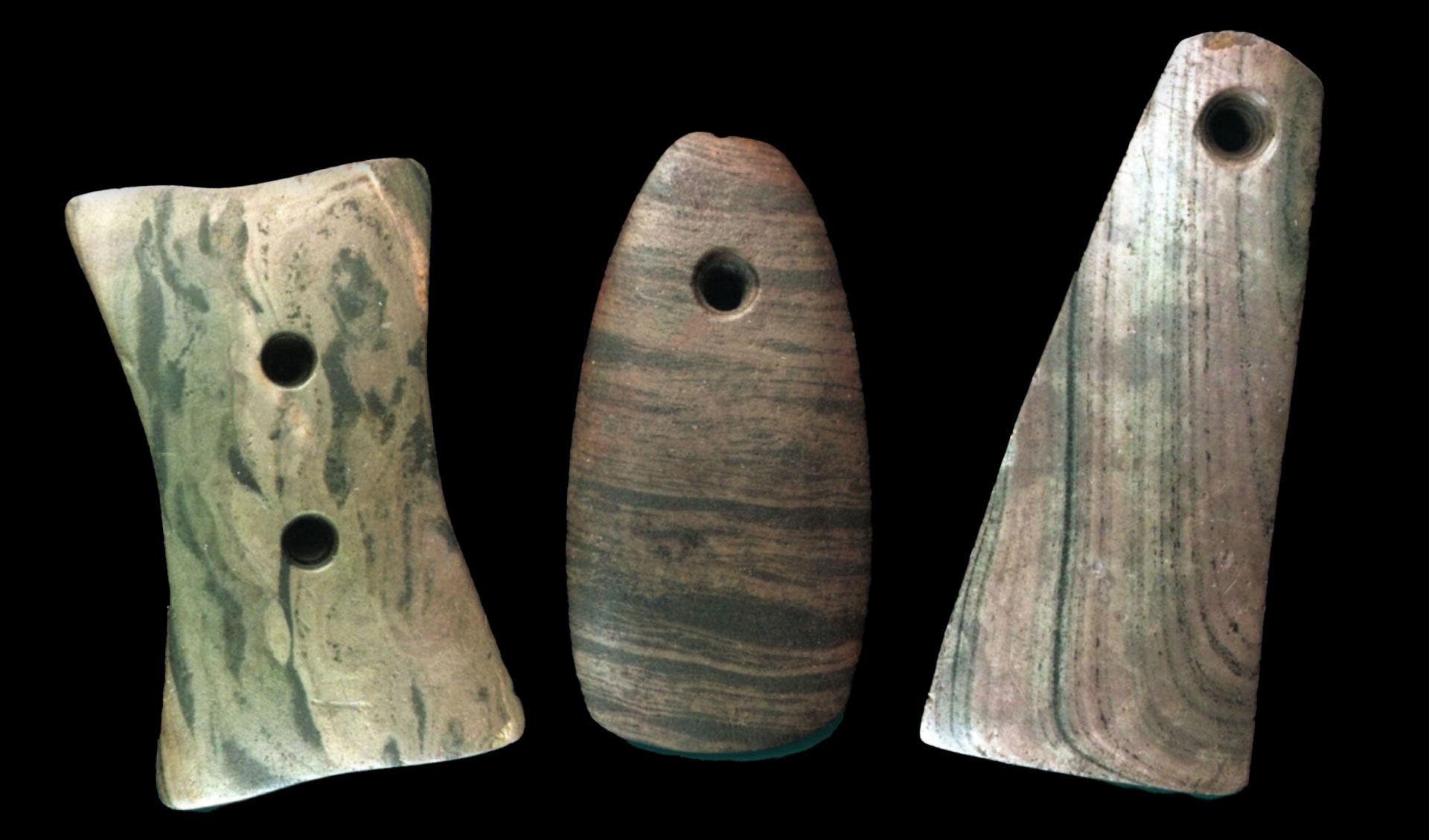
Banded slate is the stone most associated with bannerstones. Its bold stripes of black, green, gray and reddish brown made striking artifacts, and its relative softness let Archaic carvers create thin wings and precise drill holes. In Ohio, banded slate can be seen in nearly every kind of bannerstone known.
This guide covers where banded slate came from, why it was chosen, the forms carved from it and what collectors look for. For an overview of all bannerstone forms, see Bannerstones: The Complete Guide.
What Is Banded Slate?
Banded slate is a fine-grained metamorphic stone with visible layers, or bands, of contrasting color. When ground and polished, the bands stand out dramatically, and skilled carvers centered their designs on them, so the banding radiates symmetrically from the drill hole.
Where did it come from?
The exact source is still something of a mystery. No prehistoric slate quarries are known in Ohio or the Midwest, so researchers believe the slate was brought south by glaciers. An older view traced it to the ancient rocks of the Canadian Shield to the northeast. Raw chunks of slate turn up in Ohio's glacial "boulder belts," suggesting Archaic people collected and broke up glacial boulders as a source.
Why Archaic Carvers Chose Banded Slate
- Workability: slate is soft enough to shape and drill far more easily than granite or quartz.
- Thin, precise forms: its softness let sculptors carve the thin wings of butterfly and crescent forms and drill clean perforations.
- Beauty: the banding made each piece visually striking, which may have mattered as much as function.
Some of the most delicate bannerstone forms, including notched butterflies, knobbed lunates and double crescents, were made almost exclusively from high-quality banded slate.
Bannerstone Forms in Banded Slate
- Butterflies: single and double-notched butterflies, including a 7 inch black glacial slate double-notched butterfly from Michigan and a 5.5 inch slate butterfly from Dubois County, Indiana, in the McGuire and Harvey collections. See Butterfly and Winged Bannerstones.
- Crescents: including double and knobbed crescents. See Crescent Bannerstones.
- Picks: including the curved picks of the Northeast. See Pick Bannerstones.
- Ovates, lunates and others: see Notched Ovate Bannerstones and Bannerstone Types.
Banded slate was also used for other ground-stone artifacts, including birdstones, gorgets and pendants. Learn more in Native American Stone Gorgets.
Where Banded Slate Bannerstones Are Found
Banded slate bannerstones are most common in Ohio, Indiana and Michigan, with examples throughout the Great Lakes and Ohio Valley regions. Pieces carved from northern slate have also been found far to the south, a sign of how widely the material and the finished stones traveled.
How to Identify a Banded Slate Bannerstone
- Banding: clear, continuous layers of color. On the finest pieces, the bands are centered and symmetrical around the hole.
- Surface: a smooth polish that may have dulled with age. Look for natural weathering and soil staining, especially in the hole and along the edges.
- Weight and feel: lighter and softer than hardstone, and more easily scratched.
- Condition: slate splits and chips along its layers, so check thin wings and edges for old breaks or repairs.
- Drilling: ancient holes show fine circular striations, not a machine-perfect bore.
What Is a Banded Slate Bannerstone Worth?
Value depends on the form, the quality and symmetry of the banding, size, condition and provenance. Complete delicate forms such as notched butterflies and double crescents with bold, centered banding are among the most desirable bannerstones. For a realistic value, get a free bannerstone appraisal.
Banded Slate FAQ
Where did banded slate come from?
Researchers believe glaciers carried it into the Midwest, likely from the north. No prehistoric slate quarries are known in Ohio or the Midwest, and the exact source is still uncertain.
Why are so many bannerstones made of banded slate?
It was soft enough to carve thin wings and drill clean holes, and its colorful banding made beautiful finished pieces.
What else was made from banded slate?
Birdstones, gorgets and pendants, along with nearly every bannerstone form.
Have a Banded Slate Bannerstone?
Send clear photos of each side and the drill hole, with a ruler for scale, for a free appraisal. We buy bannerstones, birdstones and gorgets, from single pieces to whole collections. Learn how we buy.