
Bannerstone Types: A Visual Guide to Every Major Form
Bannerstones come in dozens of shapes. Researchers sort them into types based on their outline, the shape of their wings or body and how the hole is drilled. Knowing the type is the first step in identifying a bannerstone, estimating its age and region and understanding its value.
This guide introduces the major bannerstone types, with links to detailed pages for each. For background on what bannerstones are and how they were used, see Bannerstones: The Complete Guide.
How Bannerstones Are Classified
The standard system began with Byron Knoblock's 1939 study Banner-stones of the North American Indian. It was refined by David Lutz in 2000, and the Archaic Bannerstone Project, led by Dr. Anna Blume, now recognizes 24 types, many with sub-types. See Dr. Blume's Bannerstone Typology for the project's full list.
Not every stone fits neatly. Knoblock found that nearly half of the 3,600 bannerstones he studied were "blended forms" sharing traits of more than one type, so identification often means finding the closest match.
Winged Types
Winged bannerstones have a central drilled spine with a wing on each side. Winged Bannerstones covers the family in detail.
- Butterfly: broad wings meeting at a short central tube, in single-notched, double-notched and quartz varieties. The classic bannerstone. See Butterfly and Winged Bannerstones.
- Wisconsin wing: symmetrical, thin wings with a high central ridge, often in hardstone such as porphyry granite.
- Crescent: curved, moon-shaped wings with broad, rounded tips, including double, notched, knobbed and miniature forms. See Crescent Bannerstones.
- Lunate: a half-moon form, including the knobbed lunate, often in fine banded slate.
- Rectangular: essentially a winged form with squared corners, like a bar of soap, including barreled versions.
Curved and Pointed Types
- Pick: long and slightly curved, round in cross section, with pointed ends. Curved, straight and single-pronged forms. See Pick Bannerstones.
- Geniculate: a bent, or kneed, form.
Tube and Body Types
- Tube: an elongated stone drilled lengthwise, in round, oval, square and triangular cross sections, including fluted tubes and Mississippi's Benton phase "covered wagon" style. See Tube Bannerstones.
- Bottle: a large, expanded center section that looks like a bottle, including single-faced forms.
- Humped: a tube-like body with a hump on one or both sides, including concave forms.
- Hourglass: pinched at the middle and flared at both ends, with a somewhat square outline.
- Ball: rounded, in plain and fluted versions.
- Saddleface: a saddle-shaped form, sometimes called prismatic, including hooked and horned versions.
Oval and Shield Types
- Ovate: an egg-shaped outline, with northern, southern and notched forms. See Notched Ovate Bannerstones.
- Shuttle: an elongated form tapering toward both ends.
- Shield, panel, triangular, reel, hinge, double-edged and double-bitted axe: less common forms named for their outlines. Some pieces that fit no type are classed as anomalous.
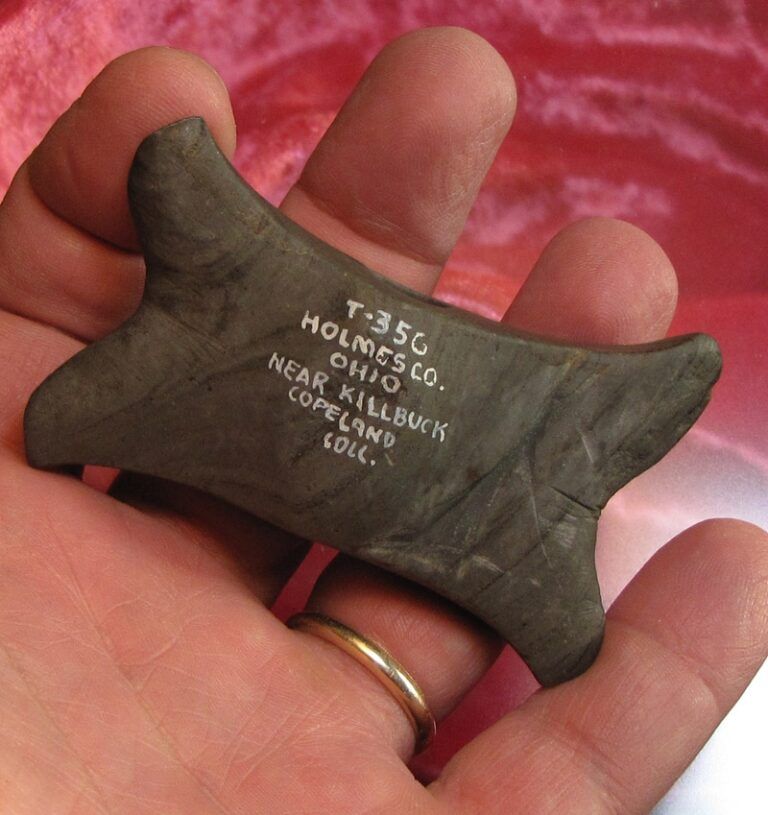
Bannerstones by Material
The same type can look very different depending on the stone. Soft banded slate allowed thin wings and crisp detail, while hard quartz produced thicker, rounder forms. Learn more in Banded Slate Bannerstones and Quartz Bannerstones.
Tips for Identifying a Bannerstone's Type
- Start with the outline: wings, a tube, an oval or a curve narrows the choices quickly.
- Look at the ends: rounded tips suggest a crescent, pointed ends a pick, squared corners a rectangular form.
- Check for notches and knobs: these define many sub-types.
- Note the cross section: round, oval, square or triangular, especially for tubes.
- Consider the material and region: many types are tied to particular stones and areas.
- Accept blended forms: if a piece sits between two types, note both.
Bannerstone Types FAQ
How many types of bannerstones are there?
The Archaic Bannerstone Project recognizes 24 types, building on Byron Knoblock's 1939 system, with many sub-types within them.
What is the most common type of bannerstone?
Winged forms such as the butterfly are among the most familiar, but common types vary by region.
Can a bannerstone belong to more than one type?
Yes. Knoblock found that nearly half of the bannerstones he studied were blended forms sharing traits of more than one type.
Not Sure What Type You Have?
Send clear photos of each side and the drill hole, with a ruler for scale, and we will tell you what you have and what it may be worth. Get a free appraisal, or learn how we buy bannerstones.