
Winged Bannerstones: Wisconsin Wings, Butterflies and More
Winged bannerstones are the forms most people picture when they hear the word bannerstone: a central drilled spine with a wing extending from each side. The family includes the classic butterfly, the hardstone Wisconsin wing and rare variants like the clipped wing, and it covers some of the most skillfully carved stones of the Archaic period.
This guide covers what makes a bannerstone "winged," the main winged forms, the stones they were made from and what collectors look for. For an overview of every bannerstone type, see Bannerstone Types or Bannerstones: The Complete Guide.
What Is a Winged Bannerstone?
A winged bannerstone has a raised central spine, drilled through lengthwise, with flat or gently curved wings extending symmetrically to either side. The term is used broadly by collectors for any bannerstone built on that wing-and-spine plan, and more narrowly for specific types such as the Wisconsin wing. Like other bannerstones, winged forms date to the Archaic period, roughly 8,000 to 3,000 years ago, and are often connected to the atlatl, or spear-thrower.
Main Winged Bannerstone Forms
Wisconsin wing
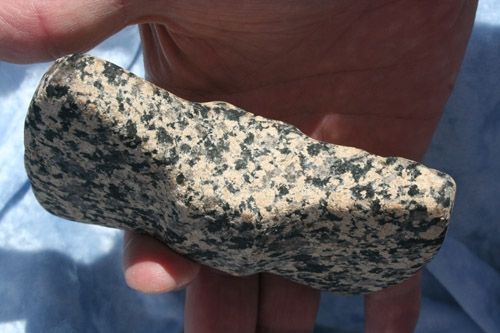
The Wisconsin wing is a symmetrical winged form named for the upper Midwest. Fine examples have thin wings and a pronounced high ridge along the spine on both faces. Wisconsin wings are often carved from hard, speckled stone such as porphyry granite, which makes them especially laborious to shape. Despite the name, they are found across a wide area: museum examples come from Wisconsin, Indiana and Iowa, and the Terry McGuire and Ed Harvey collections include a 4 inch Wisconsin winged bannerstone from St. Clair County, Illinois.
Butterfly
The butterfly is the best-known winged bannerstone, with broad wings meeting at a short central tube. Butterflies come in single-notched, double-notched and quartz varieties, and many are carved from colorful quartz or banded slate. Read more in Butterfly and Winged Bannerstones.
Clipped wing
A rare form with wings that appear cut off or squared at the ends. The McGuire and Harvey collections include a 3.2 inch Ohio clipped wing described as one of only four known.
Related winged forms
Several other types share the winged plan, including the crescent, with curved, moon-shaped wings, and the rectangular bannerstone, essentially a winged form with squared corners. Winged bannerstones were among the principal types at Archaic sites in the Chickamauga Basin of Tennessee, and winged examples are known as far south as Florida.
Materials
- Granite and porphyry: speckled hardstones, typical of many Wisconsin wings. Extremely durable but very slow to grind.
- Banded slate: softer, so carvers could achieve thin, elegant wings. Common in Ohio, Indiana and Michigan. See Banded Slate Bannerstones.
- Quartz and quartzite: used for some butterflies, which tend to be thicker and rounder because quartz cannot be carved into thin wings. See Quartz Bannerstones.
How to Identify a Winged Bannerstone
- Spine: a raised central ridge with the hole drilled through its length.
- Wings: extending symmetrically on both sides. Check whether the edges are notched (as on many butterflies) or plain (as on many Wisconsin wings).
- Thickness: thin wings suggest slate or a skilled hardstone carver. Thick, rounded wings are typical of quartz.
- Drilling: look for the fine circular striations of ancient hollow drilling inside the hole.
- Condition: thin wings break easily, so complete, unrepaired examples are valued.
What Is a Winged Bannerstone Worth?
Value depends on the form, material, size, symmetry, condition and provenance. Rare forms like clipped wings, thin and perfectly balanced Wisconsin wings in hardstone and complete banded slate butterflies are the most sought after. For a realistic value, get a free bannerstone appraisal.
Winged Bannerstone FAQ
What is a Wisconsin wing bannerstone?
A symmetrical winged bannerstone with thin wings and a high central ridge, often carved from hardstone such as porphyry granite and named for the upper Midwest.
Is a butterfly bannerstone a winged bannerstone?
Yes. The butterfly is the best-known winged form, with broad wings meeting at a short central tube.
Where are winged bannerstones found?
Across the eastern United States, from Wisconsin, Illinois, Indiana, Iowa and Ohio to Tennessee, Georgia and Florida.
Have a Winged Bannerstone?
Send clear photos of each side and the drill hole, with a ruler for scale, for a free appraisal. We buy single pieces and whole collections. Learn how we buy bannerstones.